By Jeffrey A. Rendall, Photos By Jeffrey A. Rendall
PALM DESERT, CA –Let’s just say that every golf environment comes along with its own set of expectations. When you play a seaside links course, you’d want to see something that looks like Scotland or Ireland. If you play a mountain course, you’re probably looking for elevation changes.
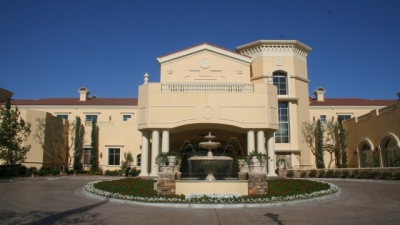 |
| The entrance to the clubhouse at the Classic Club gives a hint that you are in for something special. |
And when you play in the desert, you’re expecting cacti and scrub, right?
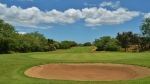
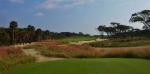
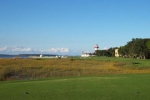
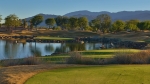
Not at the Classic Club in Palm Desert, California. The late Arnold Palmer designed gem doesn’t look much at all like a desert course – there’s wall-to-wall turf and LOTS of trees, after all. But that was by design.
Originally built specifically to host the PGA Tour’s annual Bob Hope tournament (now known as the CareerBuilder Challenge, played at PGA West in La Quinta), the original owners (the Berger Foundation) wanted a course that would be friendly to patrons attending the event, the players themselves and public play the rest of the year.
And after seeing the Classic Club, there’s little doubt they’ve done it. The PGA Tour has since moved on, but that doesn’t matter to the legions of players the golf course has attracted since opening in 2006 – and now include the club as one of the best in the region.
Greg Rubino, General Manager at the Classic Club, says it was a massive collective effort over several years to turn this previously flat and featureless piece of property into the ‘oasis’ that it is today: “The primary goal here was to create the best possible golf course – for the professionals and the people who’d be playing the rest of the year.”
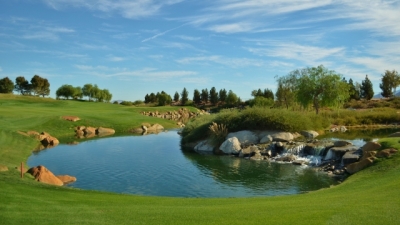 |
| Looking from the rough towards the green on the right side of the par four 10th hole. Just a small sampling of the water and rock features at the Classic Club. |
“To further that aim, the Palmer Design group worked with the PGA Tour to ensure that all the diverse needs of the facility would be met – and I certainly think they were. With respect to a Tour event, you wanted it to be very easily accessible for a gallery to walk around, as well as be viewing friendly for the golf action. The large amount of space needed to hold a Tour-sized golf tournament now benefits the average golfers who visit,” Rubino added.
But there’s a delicate balance between creating the wide open spaces necessary for the gallery and simultaneously making it stand up to the game’s best players and what they require from a golf course.
In the 21st century, challenge equals length (over 7,500 yards for the pros) and difficulty around the greens. The Palmer folks designed the course with very wide landing areas – friendly to the pros and resort players alike, but when you get up close to the hole, more precise shot-making and execution are demanded.
In other words, the course won’t beat you over the head with out-of-bounds and razor thin margins off the tee, but to score well, you’ve got to be on your game.
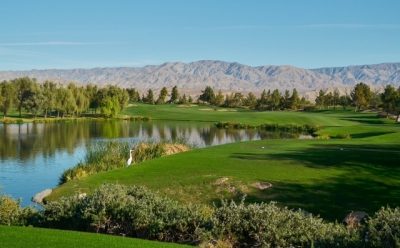 |
| There's plenty of bailout room to the right side of the par four 8th hole -- but then you're giving yourself a much tougher task on your second shot. |
Vicki Martz, Vice President and Director of Environmental Design at Palmer Course Design says they worked overtime to solve the project’s problems, including those ‘delicate balance’ issues between professional and amateur player: “What stands out about the Classic Club is, it had the most incredible ownership I’d ever come across, in terms of their commitment to making sure everything fit for the project.”
(Note: Martz now has her own design firm, you can find her website here.)
“I don’t mean to imply money was no object,” Martz elaborated, “but if in any case it made sense and would make for a great ‘stadium’ venue and best possible golf within the desert area, they were committed to providing that.”
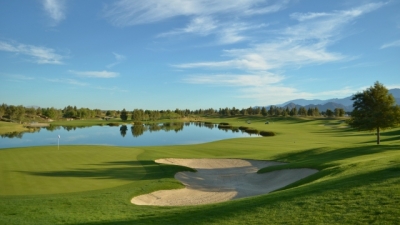 |
| In addition to the abundant lakes and streams at the Classic Club, there's ample bunkering. When you're packing for your trip, expect to bring your sand game as well. Here, looking from in back of the green on the par four 16th hole. |
The money was there, too. $38 million was devoted just for the golf course. Nothing about the Classic Club is overly brash or needlessly excessive, so the money was wisely spent.
But it had to be good to make it work. Correction, it had to be great.
As mentioned above, part of the plan that worked was building a golf course that on the one hand, didn’t ‘look’ or play like a target-oriented desert course, and two, wasn’t centered upon a housing development or upscale resort. The greater Palm Springs area has dozens of top-quality clubs and resorts, but the Classic Club is one of the few ‘core’ golf courses, with no structures in between its golf holes.
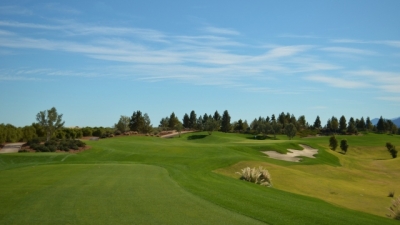 |
| It's all carry from the back tees on the par three 6th hole. For the pros, it can stretch up to 250 yards. |
It’s just golf. And there aren’t any cacti, either.
“The owners really didn’t want a typical desert course,” Martz said. “They wanted something that was big and green and undulating, that would maximize the spectacular views of the mountains, yet would be distinctive to this area.”
After seeing the Classic Club, the name ‘Shadow Creek’ (in Las Vegas) kept coming to mind, though Rubino and Martz insist that they weren’t trying to replicate or reproduce anything in particular. But at the Classic Club, you’re just a stone’s throw away at any one time from that desert sand and scrub – you just might not realize it.
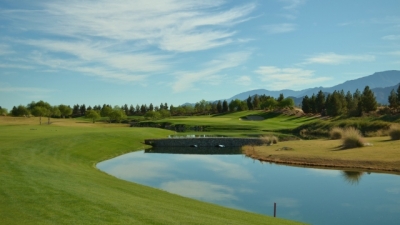 |
| From the fairway on the par four 11th, you can't help but admire the tranquil surroundings... and this little stream will catch many, many resort players' golf balls. |
An additional reason why the property maintains its somewhat isolated feel (on top of the 4,800 planted trees) is due to its laying next to a preserved habitat for the Coachella Valley Fringe-towed Lizard. There’s a large dune to the north side of the property that couldn’t be interfered with during construction, and will never be developed – assuring unobstructed views of the mountains for the Classic Club’s players… and the lizard, too.
Scaly reptiles aside, Martz said the biggest obstacle to building this type of ‘green’ course in a dry environment was irrigation. No water, no green, and if there was already a prevalence of precipitation to supply it -- this wouldn’t be, well, a desert in the first place.
She said much research went into finding the solution – how to get it big and green without needing a large stock of water, and the solution ended up being Zoysia grass, pine trees and pine straw. “We decided to plant the big, low, outer rough areas in Zoysia, which isn’t a typical grass in this area. But Zoysia grass is a very drought resistant turf, tolerates heat well, and would turn off-color during their peak season (winter), which is what they wanted,” Martz added.
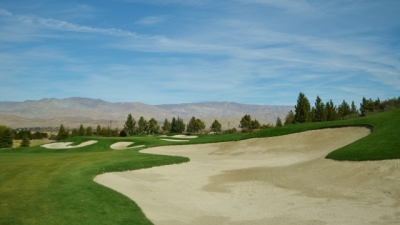 |
| Turning the corner on the 'short' par four 5th hole. At 419 yards (from the back tees), it's one of the few where nearly everyone gets a shot with a short-iron. |
“Then we landscaped the perimeters with pine trees and straw (forty acres worth). We couldn’t do it with sand because of the intense winds they get during certain parts of the year, and the drainage concerns also pointed away from using sand. And then, because of the large water features on the course, we connected them with movable streams. Even though the site doesn’t have a lot of elevation change across it, we were still able to create a sense of movement with the water,” Martz lectured.
Ah, yes, water features. The story of the Classic Club could not be told without significant attention paid to its water, and with it, the rock outcroppings bordering the wet stuff. The facility contains thirty acres of water features and fourteen bridges.
Some of those lakes are enormous, and border several holes.
Martz explained that the huge lakes were necessary to handle the off-site flow of water that eventually hits the property from the mountains surrounding the land. Everyone knows it doesn’t rain often in the desert, but when it does, it usually comes quick and heavy – and it needs a place to go.
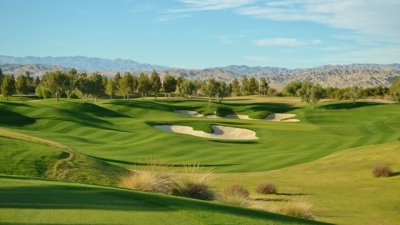 |
| It may look tame, but the green of the par three 17th hole is one of the trickiest on the course. |
Floods in a desert? You bet.
“We couldn’t release the water – we had to detain it for a certain period of time before we could release it. So therefore, there’s really almost a ‘bath tub’ effect in the lower part of the project that had to be able to hold that water. So we dug those big lakes, and they’re pretty deep, too,” Martz said.
Twenty feet deep in some spots… if you hit your ball in that water, better not go diving after it.
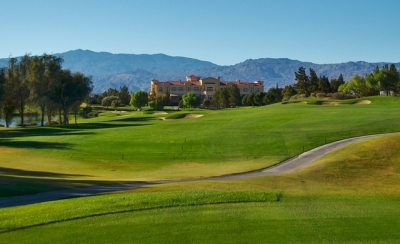 |
| The beautiful clubhouse serves as the backdrop to the long and difficult par four 7th hole. |
The soil generated from digging the lakes wasn’t moved in vain, either. Over three million cubic yards of earth was excavated and spread throughout the site to provide for some very subtle elevation variation, which not only provides the necessary drainage that Martz was talking about, but also the demanded interest that will keep players of all levels happy. It’s another way that the Classic Club differs from the normal desert offerings – it ain’t flat.
Playing the course – the Classic Club supplies the quality and quantity that you’d expect from an investment of this magnitude. Rubino talks about it: “There’s a great variety of holes, and as much as it looks fairly soft and player-friendly, there are some demanding features (the water) on the golf course that will really challenge you off the tee to select a side of the fairway to play to. But there are also bailouts. If you decide to play to the safer side, you’re just delaying the inevitable, forcing a better shot on the one coming up.”
Take your medicine, one way or another. The par four 11th hole is a good example of the old advertising slogan, ‘pay me now or pay me later.’ It’s a sweeping 459-yard par four, dogleg right with… you guessed it, water all down the right. Cut off as much as you dare on your tee ball, and if you leave it out too far to the left, you’ll be dry – but you’ll also add 30 to 40 yards to your approach shot, which must fly a stream and stick on a relatively small green.
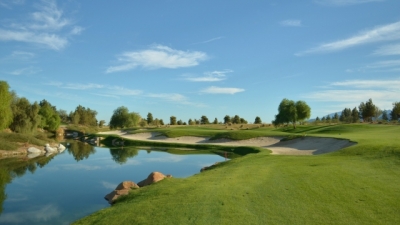 |
| At 349-yards, the par four 15th hole will get some players going for the green off the tee. But be prepared to pay if you're outside the margin of error -- which is pretty small. |
Resort players will love the abundance of ‘green’ surrounding the course. Rubino correctly points out that lost balls will be at a minimum, at least on the ‘land’ side of things.
The Classic Club will offer visitors and resort players another premium offering – service to the nth degree. “The club is managed by Troon Golf, so there will be an incredible service orientation that you’ll get at one of our facilities,” Rubino said.
He continues, “We provide a lot of extras, like yardage book, divot tool, ball marker, golf car with GPS and unlimited bottled water. We also don’t have beverage carts zipping around the course – we’ll have stationary points where we position the carts so they’re not impeding play.”
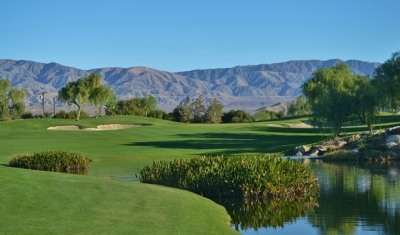 |
| By the side of the pond that borders the par four 3rd hole. You'll notice the water, but looking behind the green, you'll also see the beautiful scenery. |
“We want to make sure that when people play our golf course, that they walk away saying ‘My God, why would I even think about going anywhere else,’” Rubino added.
As for Arnold Palmer’s personal stamp? Martz says that while all of Palmer Course Design’s projects received Arnie’s attention and approval, he had many additional opportunities to visit the Classic Club in person because of its strategic location to many of Palmer’s interests. He took a particular liking to the par three twelfth hole. It’s a short hole (162 yards), surrounded by water, rock, and a waterfall.
“That hole (the 12th) was in the ‘low’ part of the property, where all the water would drain in case of a major storm – so we weren’t able to put the green right on top of the water, like Mr. Palmer prefers,” Martz said. “So, if the green couldn’t be right down by the water, he wanted to put a waterfall in front – and we had to keep moving that waterfall more and more to get it just where he liked it.”
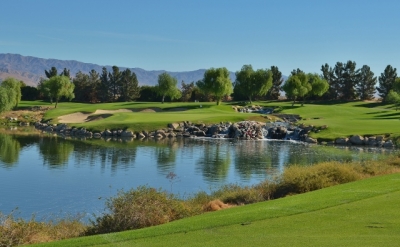 |
| 'Arnie's Golf Hole,' the par three 12th. It's the Classic Club's shortest hole, and arguably, its most memorable. Arnie likes it too. |
Palmer the perfectionist, even to the end, wished it could’ve been moved just a bit more to the front. Martz jokingly says the 12th will forever be known as ‘Arnie’s Golf Hole’ because of all his anguish over it.
Throughout, you can tell there was a whole lot of thought and input from a host of minds attributed to just about every detail at the Classic Club. It’s something unique and different in the southern California desert – and should be a ‘must play’ for any golf trip to the region.
Playing there at Thanksgiving, 2016 and 2017 brought back many wonderful memories of Palmer. I had the privilege of attending several of his grand openings and enjoyed his bantering with the always large galleries that followed him everywhere. It's safe to say the golf world will never again have a personality quite like The King. Thankfully, we still have his golf courses to enjoy.
Everytime I play a Palmer course I'll be able to relive those memories. I'm grateful for it.
Details:
PGA Head Golf Professional: Dawson Hess
The Classic Club has been designated as a Certified Audubon Cooperative Sanctuary.
Because of the vast differences in weather throughout the year, rates vary accordingly. If you want some terrific golf at bargain prices, try the desert in the summer – but only for the brave!
For current rates, click www.classicclubgolf.com
| Related Links | Comments on this article? | |
|
Maryland National Golf Club Hollow Creek Golf Club Rocky Gap Resort PB Dye Golf Club in Ijamsville Whiskey Creek Golf Club |
E-mail Jeff Rendall, Editor: jrendall@golftheunitedstates.com |