By Jeffrey A. Rendall, Photos by Jeffrey A. Rendall
LEESBURG, VA – We’re all entrenched in the mindset we take to golf courses, especially the ones we’ve never played before. Pick a set of tees, keep it in play, look over the yardage guide for the hole layouts and try to feel your way around.
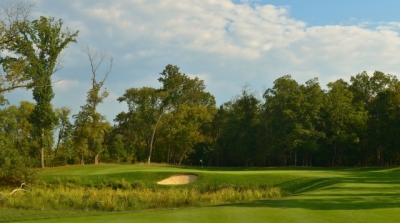 |
| It's all carry to the green of the 473-yard, par four 11th hole. As is typical on the Norman course, there's ample room to bail right, but that will leave a very difficult up-and-down. |
But when you head to the Norman Course at Lansdowne Resort, you’d better approach things differently, since this course is far from your run-of-the-mill upscale golf course experience – and demands a new way of thinking entirely.
Seeing relatively new courses is great, but there aren’t many layouts that shatter the tactical paradigm. Expect to get it around the greens in regulation, then wedge it on and try to make putts. “I want players to leave here with a little better sense of strategy,” said Craig Forgash, Director of Golf at Lansdowne. “It’s sort of become a cliché from sports psychologists over the last decade or so – plot your strategy, your line of attack… you know, work your plan.”
Forgash continues, “You really need to do that on this course, because the short-game repertoire you’ll employ here requires thought. It’s not the usual, ‘I missed the green, I need a wedge’ out there. On the Norman course, you need to assess the type of shot to play, and it’ll test your creativity and club selection. It’s all about getting it close, and how you do it. You’ll need ‘outside the box’ thinking.”
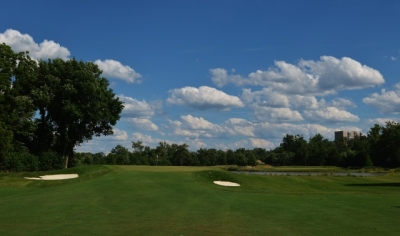 |
| The longest hole of the 'Hardest Mile' sequence, the 663-yard par five 8th presents a lengthy journey of its own -- it seems to go on forever. |
At first glance, dispensing with the usual routine seems terrifying, but after plowing through a few holes on the Norman Course, you’ll find the terror turns to annoyance if you’re trying to wedge everything from tight lies around the greens.
These are some of the toughest greens complexes around, complete with large swales, bumps and slopes. Far from goofy, but it’s also not your father’s Oldsmobile when considering the ‘ol standard chipping wedge.
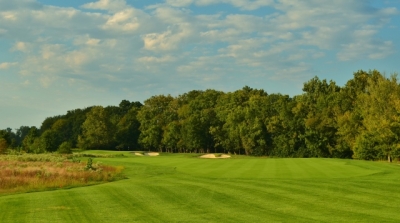 |
| The par four 15th hole presents a good example of the Norman Course's difficulty. There's ample room in the fairway, but anything curving towards either extreme will probably find trouble -- and the second shot isn't easy either. |
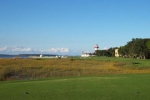
From its inception, the course was never meant to be ‘ordinary.’ Just from glancing over the landscape, you’ll know there aren’t many golf facilities quite like this. Placed in the floodplain of the Potomac River, you’ll expect a beautiful, natural, tranquil place to hit some shots, but you’ll also grasp that it’s not going to be a cakewalk to get around this track.
When Greg Norman first saw it, he seized the potential. “I was excited to design a golf course on the Potomac River, but I knew it would be a challenging site to work with because of its location in a floodplain. I specifically remember a site visit we made in the dead of winter, with six inches of snow on the ground, and it was still coming down."
Norman continues, "We scheduled a two-hour site visit to review the routing in the field. Five hours later, with the snow still accumulating, I was finally happy with the preservation of the wetlands because we’d adjusted the routing so less than ½ acre of wetlands would be impacted.”
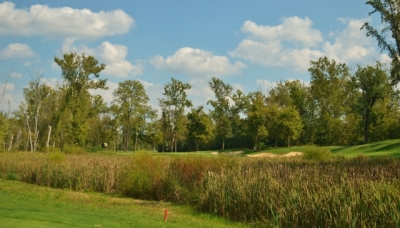 |
| The par three 5th hole precedes "the hardest mile," and offers a glimpse of some of those wetlands Norman was talking about. |
Kemper Sports Management (the project’s developer) deserves the credit for hiring Norman, seeking to add some new blood to the Washington (and Mid-Atlantic) region. Norman had always been popular with the crowds at the area’s annual PGA Tour events, and his reputation for personally inspired golf design was the right fit for this delicate piece of acreage.
Forgash insists Norman was much more than just an icon on letterhead, making several more visits than he’d contractually committed to, and devoted a tremendous amount of time to personally tweaking the course. This is truly a layout worthy of the Norman signature because it’s really his – for better, or worse.
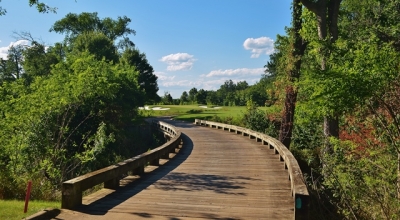 |
| At 176-yards, the par three 13th is the Norman Course's shortest hole. The well protected green will still make you earn a par. |
Mostly better. But it’s also an extremely exacting golf course, not for the wary – noting that we only saw it from the back sets of tees. Playing it farther forward will eliminate the large number of intimidating forced carries, but you’ll still have to reconcile the elevated greens complexes – and think ‘outside the box’ to get it up-and-down as Forgash recommended.
The nature of the land, in part, dictated the challenge incorporated in the design. Again, Norman expounds: “Along with our concerns with preserving the wetlands, there was the Potomac itself. The course sits within the floodplain of the river, which, on average, overflows at least every couple of years."
"We built the course to withstand the five-year flood event, which is why the majority of the greens are elevated. And we not only preserved the existing wetlands, we expanded and created additional ones to facilitate the rapid drainage of floodwaters away from the course – the result being the course will endure minimal negative impact from its close proximity to the river,” Norman concluded.
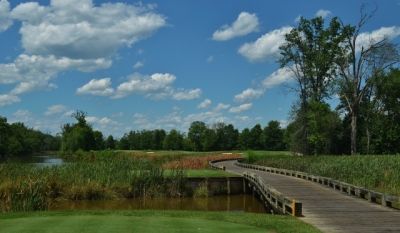 |
| The name of the game from the back tees is intimidation, and that's never more true than from this view on the tee of the par four 1st hole. |
Forgash, like Norman, cited the floodplain as one of the reasons why the course was built in the first place. For those familiar with the Lansdowne development, which includes the resort and a high-end real estate community – you’re wondering why some of that prime riverfront land wasn’t saved for seven-figure homes.
The short answer is, they couldn’t build on it because of the hundred-year flood event. The fact that the real estate is now utilized for our favorite recreational pastime isn’t a bad alternative. The golfers aren’t complaining.
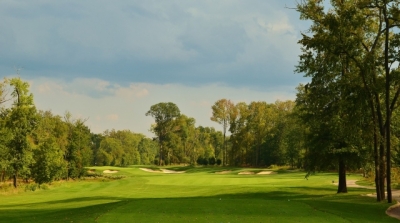 |
| The beautiful par four 10th hole. |
Forgash also said there were additional historical considerations to think about: “Along with the environmental issues, our property along the river was part of the ‘Potomac Heritage Trail,’ an old Indian pathway that runs right along the bank of the Potomac River. It goes for miles along the river and when we built the golf course, we granted a 75-foot easement off the water to accommodate the trail.”
You can’t really see it today, as there’s a dense tangle of undergrowth where the trail would be, but there’s no reason why golf can’t peacefully coexist with history and the environment in the same setting. There’s also a lock (as in, river navigation) on-site, built by George Washington in his engineering days, right along Goose Creek (you can’t really see it from the course, either).
Aside from the history and environment, there’s golf to be played. Norman describes his philosophy: “As is the case with all my designs, I strive to challenge the talented golfer, but also make it enjoyable for the novice. One way to accomplish this is through multiple tee placements. Specific to Lansdowne, since the course plays through wetlands and native vegetation, I made sure to put in generous landing areas.”
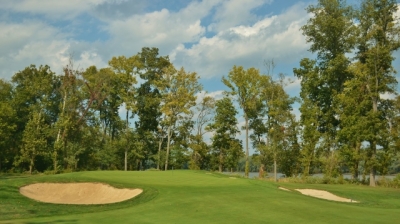 |
| Near the green of the short par four 3rd hole, you'll see the Potomac River beyond the trees. |
It is true, the fairways themselves are more than adequate – not a ‘tight’ course in any sense. And even better, the rough has now fully grown-in to help contain balls curving towards the sides.
“From a long-game perspective, the tee shots are challenging if you’re at all off-line – there’s definitely a premium on accuracy as well as distance,” Forgash acknowledged. “That being said, once you’re past the tee shot, the approaches are not terribly difficult – but if you miss a green, there’re an awful lot of short-game options available to you. And there are run-up chipping aprons for the approaches to most holes.”
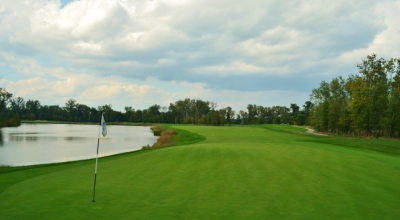 |
| The par four 7th hole has water all down the right side -- a slicer's worst nightmare. |
“It brings the ground game and bump-and-runs back into play, and I think that’s unique in this area. The course tests every shot – if you’re hitting good tee shots, then you’re approaching the greens from the proper spot, and you’re more likely to hit decent shots into the putting surfaces. But if you’re scrambling from the rough and the trees and the fairway bunkers, there’s no way you’re going to get yourself in the right positions on the greens, either,” Forgash added.
Helping to soften up the course a bit was the designer’s keen knowledge of the playing tendencies of, for lack of a better way to put it, ‘hackers.’
According to Forgash, Norman often quoted the average carry distance of a woman player’s driver, or how far a 36-handicap, three time a year player (as an example) hits his five-iron offline – and planned accordingly. And the closely-mown areas around the greens may not help these players save strokes, but it will allow them to keep the ball close to the ground and more importantly, maintain the pace-of-play.
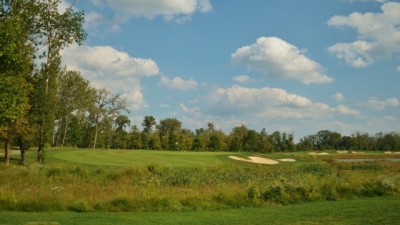 |
| It doesn't take much air to get over the hazard on the approach to the par four 6th hole, but it might make you think twice about hitting driver off the tee. |
From the tips, the Norman Course measures a super-sized 7332 yards, but even at that yardage, the spacing and length of the holes provides for good variety. “Too many times you play a course and it seems like you’re hitting a long-iron or wood into every green,” Forgash said.
“But it’s not that way on this course. It’s a long course, don’t get me wrong, but there are holes like number fourteen, a 331-yard par four that you can either pull out driver and try and get it close, or hit a five-iron off the tee and take the safe play. It depends on where the pin’s located on the green, as to what’s the best choice off the tee. The entire course presents a lot of options.”
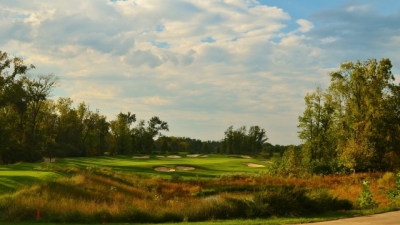 |
| It's very tempting to want to hit a driver everytime on the short par four 14th hole (331-yards), but it won't always buy you an advantage if the pin's in the wrong spot. |
No matter how you look at it, the closing sequence of holes on the front nine will make you work the hardest mile – no pun intended. Holes 6-9 measure 1760 yards, which if you multiply it out by three, equals 5280 feet. For you junior high math rejects, that’s one mile… exactly.
(Note: The nines were switched a year after the course opened. The "hardest mile" used to conclude the course, which would certainly tend to suck the life out of those who were already having a hard time of it.)
Norman talks about the concept: “When I sat down to assess the initial routing, I realized the last four holes were approximately a mile. I decided to make some minor modifications so the distance would equal exactly a mile, which provides ample challenge, and a uniqueness to the course.”
From the back tees, that’s the 408-yard, par four sixth, the 442-yard, par four seventh, the 663-yard, par five eighth and the monster 247-yard, par three ninth. Standing on the back box of the ninth hole, with nearly a full carry over water, 247-yards might as well be 500. It just doesn’t look like it’s possible.
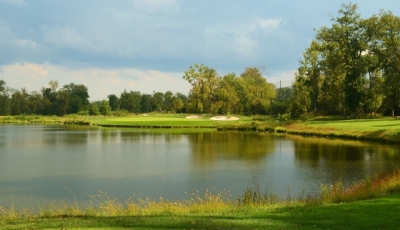 |
| The 247-yard, par three 9th hole is a full carry over water. Thankfully, there's a big target to aim for. |
Thankfully, Forgash says it plays with the prevailing wind, and the ninth green is the largest ‘target’ on the course. So if you’ve got the stick to carry the yardage, chances are you’ll at least avoid dropping for another try at it.
Along with the golf course, there’s a beautiful clubhouse and practice range at Lansdowne, both of which would rival the finest in the region, public or private. Lansdowne has always been known for providing the full resort golf experience, but now there are simply no ‘holes’ in the presentation.
The conditions are always excellent and the bunkers were renovated in time for the 2017 season. What more can you ask for?
Forgash has the last word. “I think the Norman Course is a very true reflection of what Greg intended it to be. I asked his lead architect, about a month after the grand opening, ‘was Greg happy with the way it turned out?’ He said, ‘absolutely, it’s just as he envisioned it to be.’”
Envision beauty and challenge, and that’s the Norman Course at Lansdowne. It’s about as ‘outside the box’ as you’re going to get.
Note: The Golf Club at Lansdowne is now restricted to members and resort guests. Contact the club for outing information.
Details:
The Golf Club at Lansdowne (Norman Course)
Phone: (703) 729-4071
Website: http://www.golfatlansdowne.com/
Course Designer: Greg Norman
Director of Golf: Craig Forgash, PGA
Tees/Yardage/Slope/Rating
Black 7332 147/75.4
Gold 6901 140/74.8
Blue 6504 134/72.8
White 6049 128/70.6 134/75.4 (L)
Green 5371 122/66.8 128/70.2 (L)
Rates:
Rates vary, depending on the course played and the season. Consult the website for information.
Contact the club for membership information.
Note: Currently unrestricted walking, and fairly walking friendly as well.
| Related Links | Comments on this article? | |
|
Maryland National Golf Club Hollow Creek Golf Club Rocky Gap Resort PB Dye Golf Club in Ijamsville Whiskey Creek Golf Club |
E-mail Jeff Rendall, Editor: jrendall@golftheunitedstates.com |