By Jeffrey A. Rendall, Photos by Jeffrey A. Rendall
SELBYVILLE, DE – It’s often the case in modern golf communities that the golf course serves merely as an amenity for the residents – a pleasant grassy environment providing a buffer between the houses and streets.
It’s less frequent that the golf course acts as more than just another tract of land within the neighborhood, but that’s exactly what’s unique about Bayside Resort Golf Club in Selbyville, Delaware – just inside the Delaware state line and within sight of Ocean City, Maryland.
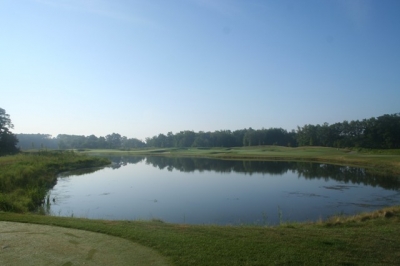 |
| The view from the tee of the par four 1st hole (440-yards) sets the stage for your round at Bayside - generous landing areas and lots of water. |
Bayside’s Jack Nicklaus signature golf course lies adjacent to the scenic and natural Assawoman Bay, providing a variety of surroundings for golfers and residents alike – and while you’re never far from the houses themselves, the golf course is very much off on its own.
In other words, Bayside’s golf product is more resort than residential – which is nice.
Golf architect Rick Jacobson served as Nicklaus’s project manager at Bayside (Jacobson had worked for Nicklaus design years ago), and he says it was the plan all along to keep the golf open to a setting all its own: “Because the site at Bayside was completely surrounded by water, it became an environmental necessity that the golf course be utilized as an open space transition between the natural environment of the bay and the residential community next to the golf course.”
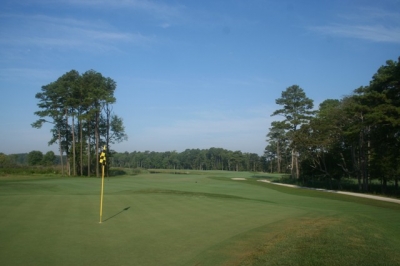 |
| Looking back from the green of the 614-yard, par five 2nd hole. It's hard to tell from this view, but the green is slightly elevated, which is a common theme at Bayside. |
Jacobson continues, “All of us had to work very closely together – the engineers, the environmental consultants, the course designer – we collaborated throughout the planning and design process with environmental sensitivity as our foundation. We went through alternative design scenarios to deal with the run-off that was incorporated into the plan while not making it look like it was engineered, so that you’d still have a nice feel to the golf course.”
“The entire project team, with the Freeman Companies (Bayside’s owner and developer) was absolutely committed to a top quality finished product,” Jacobson said.
The golf planners lucked out, because the golf course was needed to filter the community’s water run-off through an internal system incorporated into the golf course – in essence, the golf course serves as a buffer between the residents and the bay. Because of this unique arrangement, the golf holes occupy the ground closest to the water, providing a wealth of golf hole looks that aren’t usually found on a layout all at the same time.
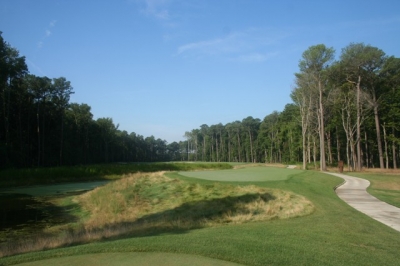 |
| The par four 4th hole (416-yards) is an example of Bayside's many different looks, with trees framing the entire hole in a parkland style. |
True to its name, Bayside offers views of the bay, but it’s also got holes meandering through wetlands, some parkland-style holes and some links across meadows – about as diverse a set of scenes as you’ll get from one facility. Throw in some mountains and you’d have it all… but then again, that wouldn’t quite fit at Bayside, where the beach theme works nicely.
And then there’s the ‘away from it all’ feeling. “One thing about a golf course community development project – you can feel like you’re playing down the middle of a housing canyon at times,” Jacobson lectured. “But at Bayside, we had the wetlands and the water features around the periphery of the property. So you may have residential development on one side of the golf hole – but on the other side, you’ll have a big, broad open space with beautiful vistas and a connection with the natural environment.”
“It won’t make it feel like you’re so tight. The quality of the golf experience has been preserved,” Jacobson added.
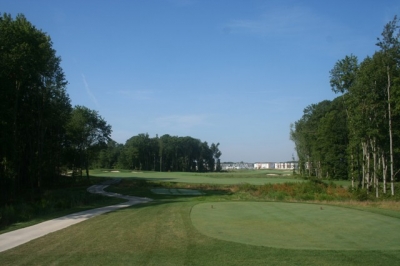 |
| It's risk-reward all the way on the par five 6th hole (555-yards), as long hitters may try to fly the marsh off the tee - but as usual, there's a shorter, safer option. |
And humans with golf clubs aren’t the only ones enjoying the natural wonderland of Bayside. As you’d expect from being located near a seaside ecosystem, there’s a plethora of bird species and other wildlife that calls the region home, and the plant diversity is abundant as well. Pines, flowering dogwoods and black cherry trees are all native to the property.
Because of this complex environment, and because there’s water (in one form or another) on all 18-holes, you’d think Bayside would present quite a challenge to make it playable for resort players.
Jacobson confirms that playability was a major concern. “We really wanted to take forced carries out of play on this golf course, so we worked extra hard on tee placement to make sure that resort players wouldn’t have to fly a lot of the natural areas. At the same time, we were able to position the back tees to provide a solid challenge for single digit handicappers.”
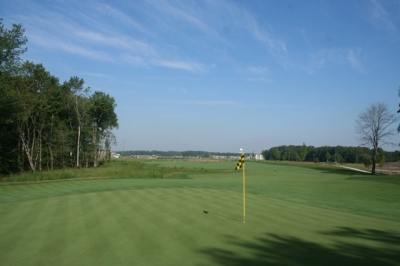 |
| There's plenty of room short of the green on the par four 8th hole, but here's a place where you'll need that short game imagination. |
There were other ways to mitigate the tough spots on the course. “We provided generous landing areas to neutralize the lateral water hazards – giving players a wide target area to keep the ball in play. In addition, we introduced greenside chipping/bail-out areas to increase the playability around the greens, while establishing some different short-game options. We also placed bunkers adjacent to the water features to contain and collect errant shots prior to entering a hazard,” Jacobson added.
Flexibility was another aspect that Jacobson stressed – how the layout can be set up differently to accommodate different groups of varying playing abilities. Tee locations and pin positions can be adjusted to suit groups of resort players, or tightened up to test the pros – and you can easily see how they’d do it when playing the course.
It’s the type of design quality you’d expect from two architects with the wealth of experience that Nicklaus and Jacobson have accumulated. Sometimes the ‘name’ architect is signed-on just to add marketing power, but Jacobson said Nicklaus’s influence went much deeper than that at Bayside. Nicklaus was involved in every aspect of construction, from Master Plan, to routing plan to providing strategic input throughout the course.
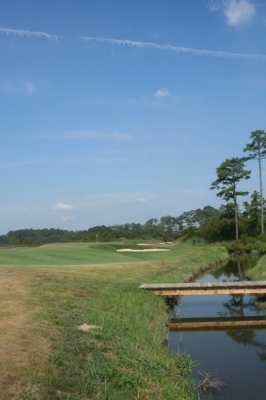 |
| Water isn't rare at Bayside, but this particular hazard divides the par four 12th - thankfully, it still shouldn't come into play. |
Bill Hamilton is Bayside’s Director of Golf, and he shares in Jacobson’s high opinion of the golf course’s unique characteristics. “While water – in the form of a pond, creek, marsh or the bay – is present on each hole, a defining feature of Bayside is the pot bunkering that Jack Nicklaus conceived just for this project, and is prevalent throughout the course.”
True enough, the bunkering is eye-catching as well as penal, with stark faces, partially covered with grass, presenting distinctive shot angles that don’t always include the shortest distance between you and the cup.
The putting surfaces are smaller, too (not the complexes, just the shortest cut), and raised for an old-style look on most holes. You’re given many opportunities to use your imagination on this course, and it doesn’t necessarily favor one type of shot over another.
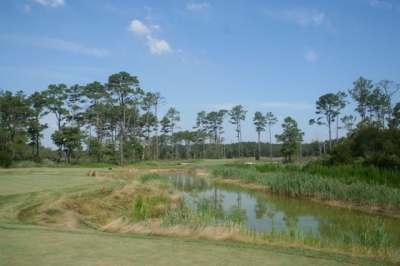 |
| Jack Nicklaus always designs great par threes, and Bayside's one-shotters are no different. Here, the par three 13th. |
One aspect we haven’t yet touched on is length – there’s a lot of it. From the ‘Signature’ tees, there’re 7,545-yards of Delaware territory between you and the flag of the eighteenth green, a big slice of real estate by anyone’s estimation. In contrast, the shortest set narrows the distance to 5,125-yards – and again, without the carries.
Hole highlights include the par three third hole. Hamilton describes it: “The third hole’s an example of the strategy and playability mix that the course offers. A salt marsh must be negotiated along the front and left, but the large green presents a friendly target. From the back tees it’s 227 yards (almost all carry), but the forward tees are only 127 yards and there’s a bailout area to the right.”
The elevated tees also reveal the Assawoman Bay off to the left, so the views are right in line, too.
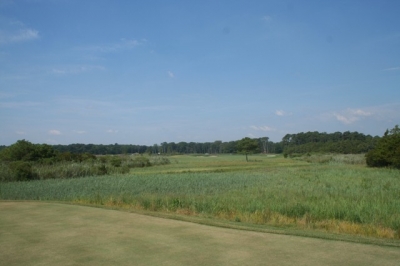 |
| The par five 14th hole (556-yards) is another chance at doing something spectacular if you can hit for distance and know where to place it. |
The 485-yard, par four fifth hole earns Bayside’s #1 handicap designation, as it’s daunting from start to finish. The hole doglegs left – but don’t try to cut too much distance down the left side, or you may catch the bunkers – or even farther left, the trees. Even with a perfect drive you’re still going to have over 200 yards left to the green – good luck!
On the backside, the 556-yard, par five fourteenth hole is certainly one you’ll remember. Again, Hamilton describes it: “A serpentine strip of marshland weaves up the fairway in the form of an ‘S,’ shaping each shot. The tee shot must avoid the marsh on the right as well as the framing bunkers on the left. The second shot is dictated by position, as is the third, with the ‘S’ marsh making its way to the left side of the fairway, and then cutting in front of the green.”
The round concludes with another Nicklaus classic, a 483-yard par four that will demand excellence from you once again to approach par. Lay it all out on the tee shot as the fairway is wide, with water down the left and plenty of room to the right – but as usual, if you bail too far to the safe side, you’ll leave a much harder approach to this smallish green guarded by bunkers in front.
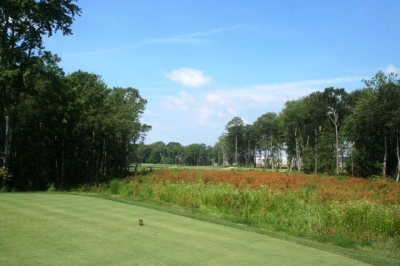 |
| The parkland par four 16th looks tighter than it really is - even from the back tees. |
Hamilton provides the closing thought, on the golf course at least: “The first thing we hope each player asks when finishing the round is, ‘What time can we play again tomorrow?’ The Nicklaus design variety and creativity should prompt that response, and hopefully our visitors will be impressed by the challenge and variety of options, as well as the natural surroundings throughout the course.”
One other aspect of Bayside deserves note, especially for those who might be considering a move to the eastern shore. “Part of Bayside’s commitment to community is a proactive approach to land preservation, balancing residential comforts with environmental sensitivities,” Hamilton said.
“To protect Bayside’s unique natural setting, we’ve invested in a conservation easement that will leave more than 287 acres of land pristine and undisturbed, with no development, private docks or motorized watercraft. The Bayside Nature Center further extends the community’s environmental stewardship, offering an opportunity for residents to explore and learn more about waterfowl, wildlife and other natural surroundings,” Hamilton added.
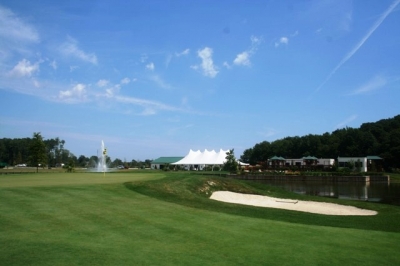 |
| Here's a look at the 18th green - by the time you reach here, you're checking your calendar for the next time you might be able to visit Bayside. |
Bayside Resort is no doubt one of the brightest new (opened in 2005) offerings in the Mid-Atlantic, with great golf in a setting that’s diverse and incredibly beautiful. It definitely deserves a look if you’re heading to the Ocean City area, or with local accommodations, can be the focus of a vacation on its own.
Where we stayed
While visiting Bear Trap Dunes and Bayside resort, we stayed at the Holiday Inn Express – Bethany Beach Hotel, which was conveniently located near the golf courses and the beach, as well as local restaurants and attractions.
Bethany Beach Hotel
710 South Coastal Highway
Bethany Beach, DE 19930
Phone: (302) 541-9200
Fax: (302) 541-4057
Email: info@holiday-bethany.com
Details:
31806 Lakeview Drive
Selbyville, DE 19975
Phone: (302) 436-3400
Website: www.golfbayside.com
Course Designer: Jack Nicklaus
Nicklaus’s Project Manager: Rick Jacobson
Director of Golf: Bill Hamilton
Bayside’s Owner: Carl M. Freeman companies
Tees/Yardage/Slope/Rating
Signature 7545 139/76.5
Championship 6835 137/72.7
Member 6418 134/71.2
Club 5615 121/67.5
Forward 5125 112/64.9
Rates:
Peak Season (June-July-Aug) -- $170
Off Season (Nov.-March) -- $100
Note: Members may walk the course; non-members are provided with a golf cart.
| Related Links | Comments on this article? | |
|
Maryland National Golf Club Hollow Creek Golf Club Rocky Gap Resort PB Dye Golf Club in Ijamsville Whiskey Creek Golf Club |
E-mail Jeff Rendall, Editor: jrendall@golftheunitedstates.com |