By Jeffrey A. Rendall; Photos by Jeffrey A. Rendall and Jeff Smith
UPPER MARLBORO, MD – “Anywhere you see the tree, it’s the same,” remarked Lake Presidential Golf Club’s Head Golf Professional, Nathan Presnal.
The ‘tree’ Presnal was referring to is the symbol that appears on Lake Presidential’s logo, which bears a striking similarity to some other logo ‘trees’ we’ve seen at notable places such as PGA West and Kiawah Island (amongst others), so it was surprising and refreshing to discover that Landmark Land Company has made its way into the Washington DC golf market – and with its new course, Lake Presidential, is already sinking deep ‘roots’ in the region.
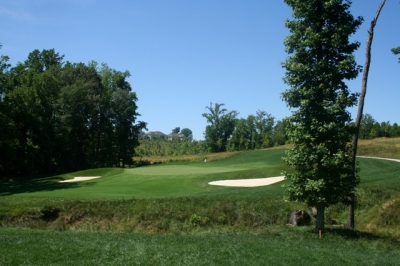 |
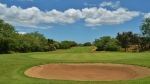
| There's a mild carry into the green of the 1st hole (485-yards), but if you play it right, the trouble shouldn't influence your play on the second shot. |
Lake Presidential actually isn’t that new, having opened on May 1, 2008 – a course that’s amazingly mature for only having hosted play for a little over a year. The layout is convenient to golfers of the DC region, being inside the beltway and just a stone’s throw from the capital as well as the Baltimore and northern Virginia suburbs.
The fact that it’s a Landmark facility only adds to its impressive list of attributes – because when you see ‘the tree,’ you know you’re in for a quality golf outing. We’ve played at several Landmark managed courses over the years and there hasn’t been a dud in the group – and now having the company based in our neck of the woods makes us fortunate, indeed.
Presnal says it was all part of the company’s desire to move to the DC region, and the Lake Presidential project allowed Landmark to do it: “The inception of the project was actually back from about 1996-1999, when Greg Norman’s people came out and set a routing for a golf course – which was subsequently turned over to the county because of a moratorium on building golf courses.”
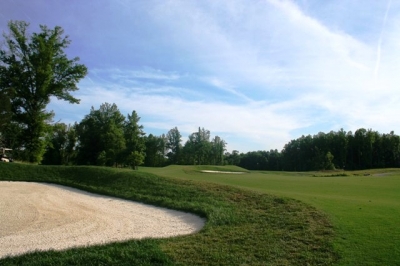 |
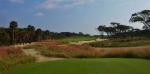
| The most interesting feature of the short par four 11th hole (380-yards) is its plateau green - you'll either love it or hate it. |
Presnal continues, “The moratorium lasted until 2005-2006, and in that interim period Landmark Land Company stepped in to do a minor re-route, and then ultimately to design the entire golf course.”
Landmark was introduced to Lake Presidential and its future development partner Ryco by a civil engineer that the company was working with on a project in the Houston area, Meadowbrook Farms. At the same time (according to Landmark’s Vice President – Director of Golf Design and Construction, Jeff Potts) Landmark was looking to relocate its corporate office to the Washington DC area, so it was actually perfect timing for the company to get involved in Upper Marlboro.
The company’s headquarters is now found off of Lake Presidential’s second fairway, having ‘moved in’ back in 1999.
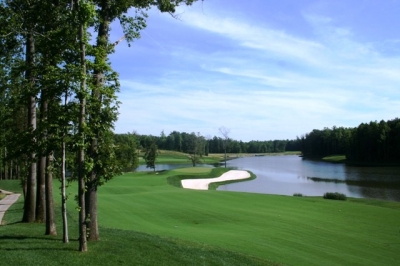 |
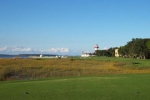
| The view from the par five 8th fairway explains why the golf facility was named Lake Presidential - quite a view. |
Potts said they were very impressed with the property’s topography – its mature trees and great soil, so there was a lot of optimism from the beginning that Lake Presidential would turn out to be something special.
But seeing as Landmark was somewhat ‘new’ to the region, there also were some ‘different’ issues to deal with during construction. Potts elaborates: “Because this was our first project in the Mid-Atlantic, we were somewhat unfamiliar with the local regulations – in three areas. There was the Stripeback Darter fish, erosion control impacting the Patuxtent River system (and ultimately the Chesapeake Bay), and then the ‘normal’ wetland issues.”
I’d never heard of the ‘Stripeback Darter,’ but Potts explained that it’s a small fish that spawns in a stream that ran through the property. Development plans called for the creation of a 30-acre lake (now called Lake Presidential, the defining feature of the property) which would be accomplished by damming the stream. The developers had to work out a method to release water from the dam in a controlled manner to sustain and preserve the downstream habitat for the fish.
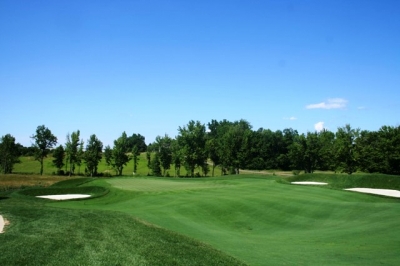 |
| Looking towards the green of the par five 3rd hole - definitely a birdie hole to provide confidence for the rest of the round. |
And then there were the erosion issues.
“Because of the sensitivity of the local rivers and streams and their ultimate impact on the health of the Chesapeake Bay, erosion control is very closely monitored in this area – perhaps the most tightly monitored of any place we’ve ever worked,” Potts explained.
“We had to install miles of silt fence – and not just the normal fabric, but a chain link reinforced silt fence known as ‘super’ silt fence. All drainage was directed through de-silting and water quality basins, many of which are now integral parts of the golf course. We also had a Prince George’s County inspector on-site daily to monitor that all these systems were being properly installed and maintained,” Potts added.
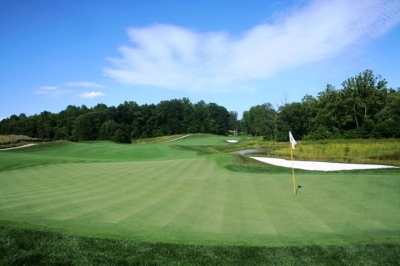 |
| From behind the 6th green - there's wetlands all up one side of the hole, but plenty of room to play it safe on the other side. |
In other words, Landmark went the extra mile in creating the golf course, and even the environment benefits.
As far as the wetland mitigation, Potts said the golf course had to absorb some of the mitigation requirements from the surrounding community (in addition to whatever was impacted by the golf course). As a result, a 3-acre wetland was created adjacent to the fifth and sixth holes, which became the mitigation for the entire development.
Because of the land and the water and the trees, Lake Presidential is a challenging golf course to the player who’s hitting it sideways – and sometimes to novice players who can’t always get the ball in the air. That’s to be expected on practically any golf course, but it’s always tricky to design a course to suit everyone.
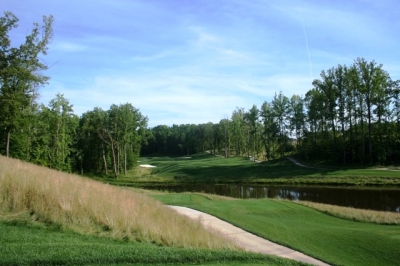 |
| The par four 10th hole looks daunting from the tee, but the most challenging aspect of the hole is definitely the second shot. |
“We were trying to build a course that would compete with the finest daily fee/public courses in the region,” Potts lectured. “To us, this meant designing a course that was a fair but stern test of golf with conditioning that was high quality yet sustainable on a daily basis. Landmark Land golf courses also have a reputation for being quality tournament venues, so that was certainly an objective as well.”
That being said, Potts admitted that it’s extremely difficult to design a course for all abilities – making a course that keeps better players challenged and interested isn’t always playable and enjoyable for a beginner. Taking these contradicting goals into consideration, they put in both challenge and playability at Lake Presidential.
Again, Potts explains. “We designed the course to be accessible from the front and put added focus on the ground game, especially around the greens. We’ve tried to create multiple recovery options around the greens by designing in a lot of short-grass and chipping areas. This forces the more experienced player to consider options other than a lob wedge, which is a difficult shot for a beginner, and gives everyone else an option to chip or putt from off the green, which is an option that may be more suited to their ability.”
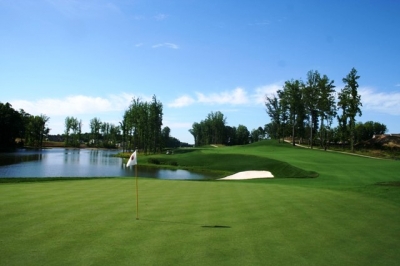 |
| From behind the green of the par five 8th hole (570-yards), you'll see the beauty and challenge that is Lake Presidential. |
And let’s not forget about fun.
“People want to have fun at the golf course, so we’ve tried to design in a little fun, too,” Potts mused. “For many, this means being able to hit the driver, no matter which set of tees you play. Taking this into account, we’ve tried to make the fairways, landing areas and corridors as wide as possible. Lower handicap players will find that although the fairways are wide, there is usually a preferred position that allows the best approach to the greens.”
True to Potts’ words, Lake Presidential is about as playable as they could make on a very varied piece of property. It plays like a resort course from the forward sets of tees, but from the back sets (7230-yards from the tips), you’ll have all the challenge you can handle. You’ll be forced to hit it straight as well as long to give yourself a favorable second shot on every hole.
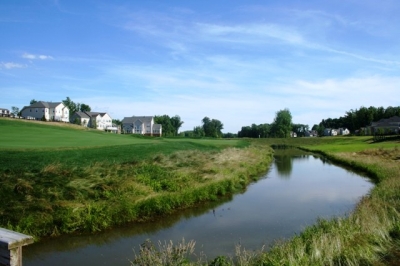 |
| The par four 7th hole (445-yards) carries Lake Presidential's #1 handicap designation - and this stream is a major reason why, influencing both the drive and approach shots. |
But it’s also not a series of bruising holes followed by a couple easy ones. The sequencing of the holes merits accolades as well, according to Presnal. “You’ll have a hole that really tests you, but then you might turn right around and the next hole will be a risk-reward birdie opportunity. So even if you make a bogey, you’ve got a chance to come right back and make a birdie and it doesn’t kill you.”
Presnal credits Landmark’s extensive experience in creating resort golf with the ‘resort’ quality at Lake Presidential, with wide fairways and slopes designed to guide balls back in play that might otherwise bounce towards trouble – and then, requires precise iron play into the greens to make a good score.
As Potts alluded to above, a few of the holes will be difficult for high handicappers to come close to par – or even finish, for that matter. The par four fifteenth hole plays 450-yards and uphill (a much more manageable 360-yards from the white tees), and there’s the usual wide landing area for tee shots. The duffer dilemma starts on the second shot, however, as you’re required to clear a sizeable ravine to reach ‘safety,’ a daunting shot for any player – but especially short hitters.
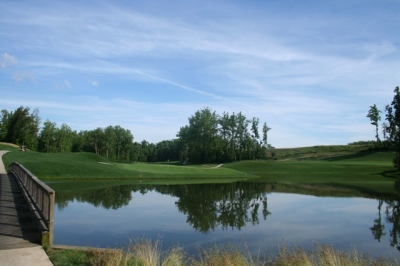 |
| The par three 9th hole plays over water from every tee box, but there's still plenty of land to spare your golf ball a watery death. |
“The designers were sort of hamstrung in certain cases by the routing and the real estate plan – so some carries couldn’t be avoided,” Presnal explained. “Fifteen does have the ravine on the second shot, but there’s room in front to miss short, and some room behind the green to miss long and hit plenty of club.”
“That’s why we’ve ‘switched’ pars on fifteen and eighteen for ladies and seniors, making fifteen play a short par five (where you can lay up just short of the ravine, then pitch it over), and eighteen (a par five that requires a long shot over water from the back sets of tees) will become a manageable par four with no water carry,” Presnal added.
Both Presnal and Potts pointed out the more than fair manner which the course concludes, with a potentially drivable short par four seventeenth (355-yards from the back) and a fairly gentle par five eighteenth hole.
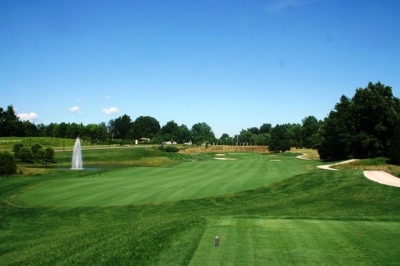 |
| After a tough first hole, Lake Presidential offers a bit of a breather on the reasonable par four 2nd (395-yards). |
“Both the seventeenth and eighteenth holes are ‘half par’ holes, so to speak,” Potts elaborated. “The seventeenth is short and potentially drivable, and the eighteenth is reachable – these types of holes seem to appeal to everyone and give players the opportunity to finish on a positive note. Considering the course was recently named the number-two daily fee course in Maryland means to us we are on our way to meeting our goals.”
“However, we feel we still have room to improve,” Potts humbly admitted.
With Lake Presidential’s level of service that goes along with the Landmark name, a beautiful and functional clubhouse and a professional staff that knows how to manage great golf courses, it’s not a stretch at all to predict that Lake Presidential will remain highly placed amongst Maryland’s best golf courses.
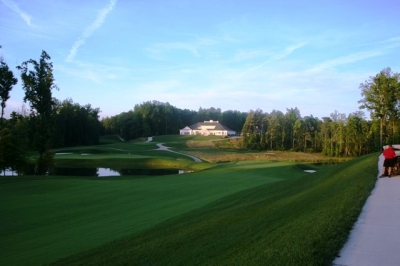 |
| Finishing up on the reachable par five 18th hole - the view will remind you of why you'll want to come back to Lake Presidential. |
And the ‘tree’ will make sure of it.
Note: Landmark Land Company is listed as the designers of the course, with Jeff Potts and Chris Cole (Senior Vice President, Director of Golf) as co-designers.
Details:
Lake Presidential Golf Club
3151 Presidential Golf Drive
Upper Marlboro, MD 20774
Phone: 301-298-9999
Website: www.lakepresidential.com
Course Designers: Landmark Land Company (Jeff Potts and Chris Cole)
Head Golf Professional: Nathan Presnal
Tees/Yardage/Rating/Slope
Championship 7230 74.6/134
Black 6775 72.2/129
Blue 6440 69.8/124
White 5925 68.5/119 75.0/136 (L)
Red 4955 70.1/126
Rates:
Rates vary by day of the week and time of day.
During the week, the top rate is $79. Weekend is $95. After two and after four, rates go down $10 on each (to $69 and $59 accordingly, on weekdays, to $85 and $75 on weekends).
Memberships (non-equity) are also available on an annual basis, with similar privileges to what a private club would offer – preferred tee times, member events, member accounts and discounts in the golf shop and with food and beverage.
Lake Presidential is also open to outings and events.
All Rates include Greens Fees, Golf Car Fees, and Complimentary Practice Facility prior to play.
| Related Links | Comments on this article? | |
|
Maryland National Golf Club Hollow Creek Golf Club Rocky Gap Resort PB Dye Golf Club in Ijamsville Whiskey Creek Golf Club |
E-mail Jeff Rendall, Editor: jrendall@golftheunitedstates.com |