
By Jeffrey A. Rendall, Photos by Jeffrey A. Rendall
GORDONSVILLE, VA – Golf Architect Ed Carton said there were many things that stood out about his work at Spring Creek Golf Club, but what he’ll always remember was the team effort needed to bring it into being.
“I’ll always look back on Spring Creek as the ultimate end-product of a great team,” Carton elaborated. “The owner (Charles Kincannon) is a quality person in what he develops and in his character as a person. The same goes for his crew, Brian Vincel (the course superintendent), Jack Snyder (Director of Golf), and his planner, Pete Bradshaw – quality all the way.”
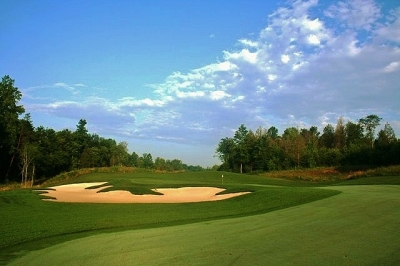 |
| Turning the corner at the par four 1st hole - by this point, you'll already realize you're in for terrific playing conditions during your round. |
Carton continues, “The quality is evident from the moment you pull onto the property until the time you drive away. I can design a great golf course and it may look great the day it’s finished, but what happens after that day is just as important – the folks at Spring Creek do a wonderful job of caring for the facility.”
I’d have to agree with Carton’s assessment, and I’m not the only one. Spring Creek won Golf Digest’s ‘Best New Affordable Public Course’ award in 2007, so the ‘team’ Carton was describing must have done – and has continued doing – something right to deserve all the attention.
Spring Creek is one of those surprises that doesn’t come along very often, a course that resides relatively anonymously in the center of Virginia (near Charlottesville), draws national awards (such as the one mentioned above, and one coming up from Golf World magazine) and lets quality speak louder than hype – if that’s possible.
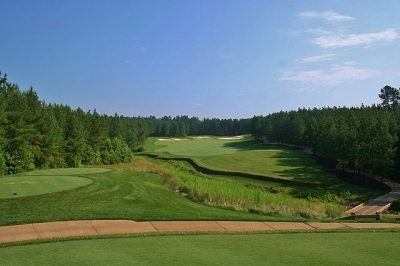 |
| Jack Snyder says the par four 11th hole has a 'North Carolina' feel due to the pine trees lining the fairway. |
Simply put, Spring Creek is already a Virginia classic, and it’s only a couple years old.
It’s drawn comparisons to another highly rated club just down I-64 in Richmond, the exquisitely done Kinloch Golf Club, which many consider to be Virginia’s top golf course – the only difference being Spring Creek is open to the public, and Kinloch… isn’t.
It only makes sense that a course of Spring Creek’s quality wasn’t done on its own, and wasn’t created by one mind or the work of one person. That’s where Carton comes in, along with the line-up of teammates that he was kind enough to introduce above.
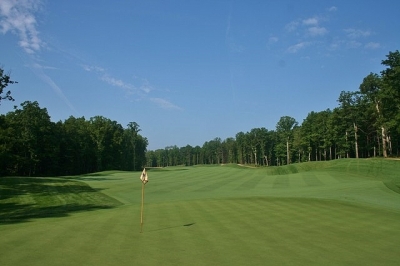 |
| The relatively short par five 9th hole (495-yards) provides a bit of a breather before tackling Spring Creek's difficult back nine. |
Spring Creek’s ‘team’ was originally set to include Virginia golf legend Sam Snead, and the course was going to be a member of Virginia’s version of a golf ‘trail’ – similar to those in some other states, such as Alabama’s ‘Robert Trent Jones Golf Trail.’ The 2001 terrorist attacks intervened, however, and Snead’s death in 2002 ultimately led to the shelving of the ‘Sam Snead Golf Trail’ concept.
The only course that Snead himself worked on was Poplar Grove in Amherst (which was designed by the collaborative efforts of Carton, Snead and Sam Snead Jr., better known as ‘Jack’) – and it’s a shame that the idea never came to full fruition. Carton thinks the idea still could work, but it’s a good thing that at least some of the other ‘trail’ courses came into being (Blue Ridge Shadows and Pendleton Golf Club, to name a couple). Like Spring Creek, they were built separately after originally starting out as part of the trail.
Despite the ‘trail’ setback, Snyder says Spring Creek was an idea that was just meant to be: “Mr. Kincannon bought this property with the intention to create a community around an enormous lake – but he couldn’t get the Corps of Engineers to allow him to build the lake. So, in talking with some of his friends, he asked ‘how can I make a piece of property out in the middle of nowhere valuable?’”
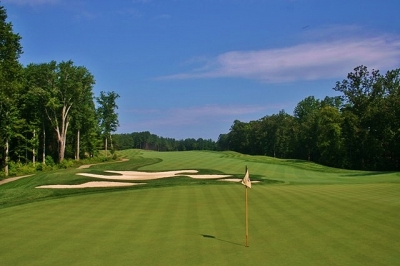 |
| The 528-yard, par five 12th hole plays downhill - a good birdie opportunity if you keep it in the fairway off the tee. |
“And they said, ‘build a golf course,’” Snyder added.
Kincannon then tabbed Carton to design the golf course. Carton was just finishing up work at Poplar Grove with the Sneads at the time, and he said Jack Snead even came out to Spring Creek on several occasions in the early days of the project and contributed some input – though it was more like friendly advice than as a member of the team.
Construction began in 2005 and the course opened in 2007 – and the accolades came soon after.
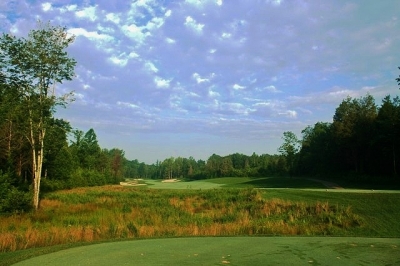 |
| Like most holes at Spring Creek, there's plenty of room to drive the ball on the par five 2nd hole - but staying out of the thick rough is a must. |
As you make a trip around Spring Creek, lots of little things cry ‘expensive,’ which makes the ‘Best Affordable Course’ designation even more surprising. First and most noticeable are the bunkers – the sheer size of them and their prevalence throughout the layout. Anyone who knows something about golf course construction knows that bunkers are expensive – primarily because of the sand needed to fill and maintain them. Big bunkers increase the costs of building a golf course considerably.
Next are the beautiful stacked stone walls that show up in various places, which according to Carton, were largely constructed by superintendent Brian Vincel and his crew. Vincel is native to the area and Snyder says he took special pride in the course’s construction and its upkeep – and it shows.
As a side note, Vincel was out working solo the morning we played, trimming brush and stacking rock – adding touches to an already nearly flawless golf course.
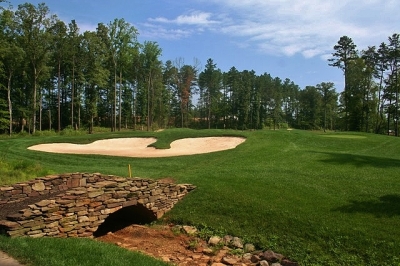 |
| You'll need to cross this stone bridge to reach the green of the par three 13th hole - yet another classy touch at Spring Creek. |
It was no surprise to learn that Vincel was a top assistant at Kinloch Golf Club prior to coming to Spring Creek, where he apparently studied well the methods of maintaining a stunning visual golf course – and also, apparently how to construct stacked rock walls. Well done.
A final ‘expensive’ feature at Spring Creek is the course’s wide setbacks from the housing development. Granted, few of the homes that one day will overlook the course have actually been built, but Carton says Kincannon wanted to make sure that the golf course always enjoys plenty of room.
“Mr. Kincannon wanted to build a great golf course, and he was willing to give up plenty of land to make sure that there was a quality end product,” Carton elaborated. “Because he knows a great golf course is going to sell great homes.”
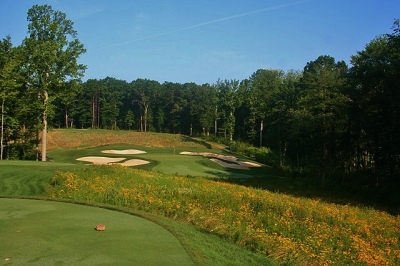 |
| The green of the par three 5th hole is framed perfectly by bunkers - and on the tee, by wildflowers. |
There were personal pragmatic reasons for it, too. “Mr. Kincannon lives along another golf course in the area, and he says he doesn’t like golf balls bombarding his yard,” Carton mused.
Such foresight isn’t always present in today’s golf residential communities, but both the residents and the golfers will benefit from it at Spring Creek.
Snyder was also quick to point to Spring Creek’s bentgrass tees and fairways as another feature that’s rare in the area (and another contribution from Vincel’s experience at Kinloch, which features beautiful bentgrass surfaces). An easier solution would have been to grow Bermuda grass or Zoysia, as the majority of courses do in the region – but Spring Creek was meant to be different from the start.
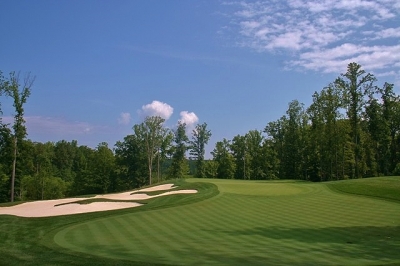 |
| Practically every hole offers a postcard look at Spring Creek - for us, it's here at the par four 15th hole. |
And bentgrass doesn’t go dormant during the winter months, assuring that Spring Creek will look beautiful year-round.
For a course built on such a grand scale, it can be intimidating to face it for the first time – and according to Snyder, overcoming Spring Creek’s visual intimidation is the first step to playing well there. “I think from the tee box, the fairways don’t look as wide as they are. When a player’s standing on the tee, he might think ‘oh boy, this is a tough hole, it’s really narrow.’”
He continues, “And then when you get out there, regardless of where you hit your ball, you just kind of stand there in the middle and think ‘gosh, I had thirty yards left and right of me – this fairway is pretty wide.’”
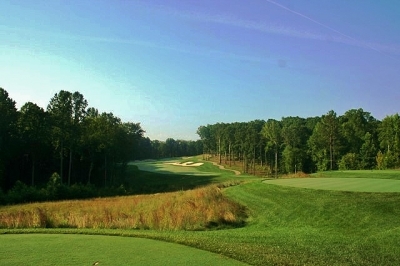 |
| The tee shot on the par four 6th hole is one of those that looks tighter than it really is. |
Carton spent many years honing his design craft under the tutelage of Tom Fazio, and as a result, his work appears difficult – but plays friendly. Carton also coined a new term, which probably isn’t unique to Spring Creek, but certainly describes it.
“I tried to make Spring Creek Fazio-esque,” Carton explained. “That basically means that the course is very visually appealing to look at – that it’s made to fit into that particular environment. Everything just fits. It’s a hard thing to describe, but the course should blend well into the landscape and look very natural – but also be very playable.”
Spring Creek is playable, but it’s also a brute from the back tees, totaling 7,172 yards from the tips and rolling in at a hefty 144 slope (74.7 rating).
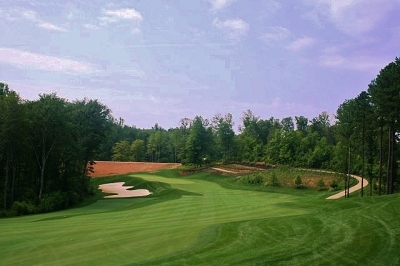 |
| The par four 16th hole offers an impressive backdrop of landscaping and stone. |
Of course, the bunkers are part of the Fazio-look – big, bold and roundly shaped. If you hate bunkers, they could play on your mind. But you also shouldn’t lose sight of the green grass that’s out there – and there’s a lot of it.
One place you’ll find grass is in front of the putting surfaces, and that’s one of the ways the course is player friendly. “There’s always an entryway where you can roll the ball onto the green if you’re not a great striker, which helps the course play a little easier for higher handicappers,” Snyder said.
Spring Creek is one of those courses where every hole is a highlight, but favorites included the par four third hole, which Snyder described as the ‘most difficult par four in Virginia.’ It plays 470-yards from the back tees, and as usual, the tee shot landing area is extremely generous – but all the challenge is on the second shot, which must carry Spring Creek to reach a green perched on a stone wall.
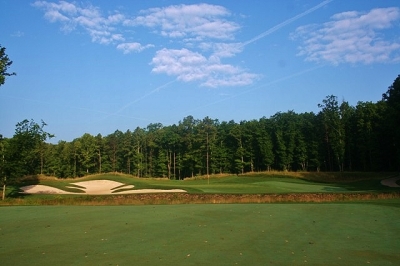 |
| The 470-yard, par four 3rd hole is rated Spring Creek's toughest - and with a long carry over this stone wall on the second shot, it deserves the designation. |
Five is a terrific par three (199-yards) which plays slightly downhill to a green protected by large bunkers on three sides (not the front, obviously) – a beautifully framed golf hole.
The back side is a bit more undulated, offering some different types of views – and it’s spectacular from start to finish. Snyder says the eleventh hole is a favorite, and describes it this way: “The eleventh hole’s got pine trees (as opposed to hardwoods on most of the course), which gives you a North Carolina feel. I guess that area of the property was timbered-out many years ago and was re-planted in pines.”
The eighteenth hole provides a fitting conclusion to a round at Spring Creek, a 575-yard par five that hugs the property’s largest lake. Snyder says the hole’s always been pretty to look at – and now it’s a lot of people’s favorite to play, because it was redone to smooth out the tee shot landing area (balls had previously been rolling down the right-to-left slope towards the lake).
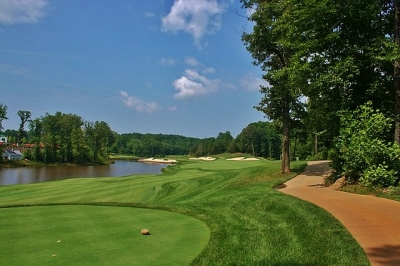 |
| Spring Creek's 575-yard closing hole completes your day on a golf course you won't soon forget. |
Like many new courses these days, Spring Creek’s pro shop is operating out of a temporary facility, but that doesn’t mean it’s short on the ‘necessities’ of golf in terms of food or golf-related service. There’s everything you’ll need for a day at the course, including a well thought-out practice facility.
The addition of a completed clubhouse will only make Spring Creek better – and reinforce its high position on Virginia’s best courses list. And the ‘team’ at Spring Creek wouldn’t have it any other way.
Where we stayed
 |
| The Hilton Garden Inn, Charlottesville |
On our most recent trip to the Charlottesville area we stayed at the Hilton Garden Inn, which offers a fine place to stay for golfers visiting the region.
The Hilton Garden Inn offers spacious rooms with one king or two queen beds, a 32” high definition flat tube television, a Mirra desk chair by Herman Miller, a clock radio with jack for a portable music player, a refrigerator, a coffee maker, a microwave, a hair dryer, an iron and an ironing board.
In other words, it’ll save you time in your trip preparation – and once you get there, you won’t have to worry about very much.
Being a relatively new hotel property, the Hilton Garden Inn also offers complimentary high-speed internet, a complimentary 24-hour business center (if you’re traveling during the week), a 24-hour pavilion pantry stocked with snacks, drinks and everything you forgot. Our kids also enjoyed the indoor pool, and there’s a workout room in case you didn’t expend enough energy out on the golf course.
All in all, a very nice place to take a break at the end of an exciting day out on the links.
Hilton Garden Inn Charlottesville
1793 Richmond Road
Charlottesville, VA 22911
Phone: (434) 979-4442; FAX (434) 979-4418
Weblink: http://www.hiltongardeninn.com/en/gi/hotels/index.jhtml?ctyhocn=CHOCHGI
Details:
Spring Creek Golf Club
109 Clubhouse Way
Gordonsville, VA 22942
Phone: (540) 832-0744
Website: www.springcreekliving.com
Course Designer: Ed Carton
Owner and visionary: Charles Kincannon
Director of Golf: Jack Snyder
Course Superintendent: Brian Vincel, GCSAA
Tees/Yardage/Slope/Rating
Championship 7172 144/74.7
Marble 6761 139/72.0
Onyx 6291 136/70.5
Salmon 5518 126/67.2 132/71.6 (L)
Pewter 4832 123/68.1 (L)
Spring Creek has an unrestricted walking policy – you may walk anytime.
Rates and Membership:
Fall (2009):
M-Th: $75; $60 after 11:00 am.
Fri-Sun: $90; $75 after 11:00 am.
Starting in November:
M-Th: $55; Fri-Sun: $70
Consult the website for further rates.
Membership:
Resident (within 40 miles): $4000 initiation fee, $250 monthly dues.
Non-resident: $3000 initiation fee, $150 monthly dues.
Cart fees are extra.
| Related Links | Comments on this article? | |
|
Maryland National Golf Club Hollow Creek Golf Club Rocky Gap Resort PB Dye Golf Club in Ijamsville Whiskey Creek Golf Club |
E-mail Jeff Rendall, Editor: jrendall@golftheunitedstates.com |