By Jeffrey A. Rendall, Photos by Mike Tanner
RADFORD, VA – John Norton is the Head Golf Professional at the River Course of Virginia Tech, but he’s also a philosopher. “There’s a saying in the golf business,” Norton waxed poetically – “that we’re not consuming anything except time, and time is all we have.”
“I think the time spent here at the River Course is what really adds to the experience – the beauty of the place, the quality of the golf course – it’s just a great way to spend your time,” Norton added.
Indeed. Golf is one of those things in life that can occasionally become transformational, and if there’s a place where it’s possible to ‘take you away from it all’ for at least a few hours, it’s the Pete Dye-designed River Course, which resides alongside the New River in southwestern Virginia, about fifteen minutes from the Virginia Tech campus in Blacksburg. The golf course itself occupies a pristine piece of land with water, mountains, trees (and a few houses) as a backdrop – quite a setting for your time ‘consumption’ practice.
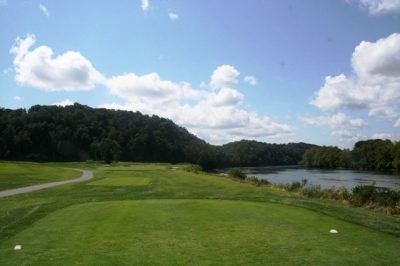 |
| The par five 3rd hole is the first where the New River comes into play - but don't lose focus on where your ball's supposed to go. |
As you might expect from a university owned and operated facility, the River Course came about because of the efforts of alumni – one particularly notable VA Tech supporter in particular, Bill Goodwin. Goodwin is an avid golfer who’s perhaps most famous for developing Kiawah Island Resort in South Carolina (host of the Ryder Cup and 2012 PGA Championship), and in building the River Course, he wanted to provide a world-class facility for the Hokie golf team.
The Pete Dye version of the course is actually the second golf layout to occupy the property, the first being an Ault/Clark design that opened in 2000. Goodwin’s long history with Dye led to the architect’s involvement in the project, with work beginning on the ‘new’ course in 2005 (and completed later that year).
 |
Norton says the need for a university golf course came about because the Inn at Virginia Tech was built on part of the modest golf course that is adjacent to campus – but that particular course was not suitable for NCAA golf competition in any case.
When it was learned that the ‘former’ River Course was up for sale (the previous owners were Tech alums Bill and Jennie Allman of Lynchburg, who now own Ivy Hill Golf Club), Goodwin saw it as a good chance to give his alma mater a gift that would allow it to host NCAA events. VA Tech had just joined the Atlantic Coast Conference at the time, and would need a facility to match its elevated competitive stature.
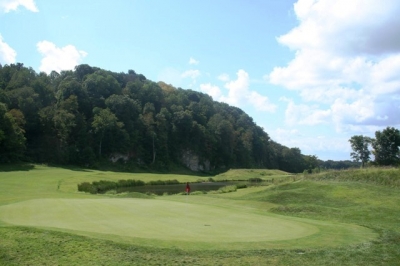 |
| Looking back from the 4th green, you'll appreciate the way Pete Dye laid out the golf hole and fit in the natural elements as well. |
Goodwin had had Pete Dye design the famous Kiawah Ocean Course, so it was a logical next step to ask Dye to come up the Blacksburg area to map out the ‘new’ VA Tech layout as well. Dye wasn’t even sure where the university was at first, and in typical Dye fashion reportedly said “Blacksburg? Blacksburg where?”, upon being asked to take the job.
Dye’s familiar with it now, and he’s proud that he was able to give Goodwin and the university a course that they could call their own: “You’re doggone right I’m proud of that course,” Dye mused. “It’s like when you’re a scribe – you don’t get paid much to do it, but when you do a university course, it’s a lot of fun to do.”
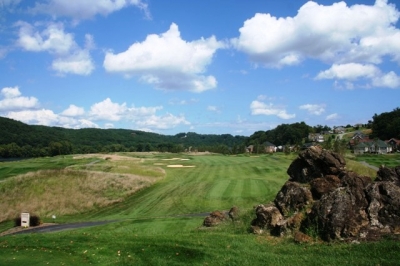 |
| The back tee box on the par four 6th hole is elevated and placed amongst rock outcroppings. |
Dye’s as colorful as his golf courses are unique, and he said that what they really tried to do with the River Course was ‘use the river.’ “It wasn’t a renovation there, it was a ‘blow it up and start over’ type situation. We started by taking out a lot of the boxelder trees along the river, which had replaced most of the native trees that must’ve been timbered long ago. We left the sycamores that we found there, which are very beautiful – but we really tried to open up the river views for the players.”
It was more than just taking out trees – it was putting them in, too. “Along the edge of the big bluff (where the clubhouse resides), we’ve planted thousands of trees. I put old ones in there – we went to the State of Virginia and got all the native trees and planted thousands of those. When they mature, it’s going to be quite a scenic place.”
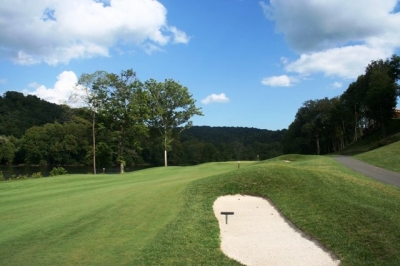 |
| The tee shot landing area on the par five ninth is framed by the river on the left and bunkers on the right. |
Dye thinks the River Course is a strong golf course for ‘those kids,’ the members of the golf team, but he also believes the course will be a long-term success for the team and the university because it’s something that other clubs in the area don’t provide – a championship caliber layout.
Norton agrees, of course, and says the course represents the ‘modern’ Dye – meaning, it’s not as difficult (in some ways) as many of the architect’s early works: “Everybody has a perception of what a Pete Dye golf course is, but you can play this course and not lose a single ball – and you also know that Pete’s presence is there. There aren’t a lot of demand carries or other crazy things like you’d see on the ‘early’ Pete Dye courses. He could’ve put in more dramatic things than he did, but the playability is substantially greater because of it.”
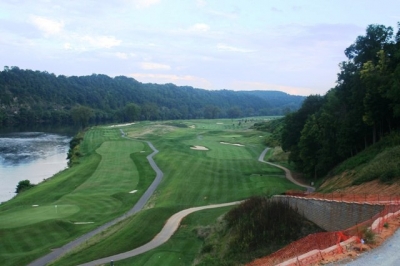 |
| The clubhouse was in the construction phase when we visited - but you can already see the view potential from the back deck. |
Not having seen the earlier golf course, I can’t speak to the ‘before’ and ‘after’ versions, but Norton says the greens were much larger on the first course, and there weren’t the collection/chipping areas around the greens that are in place now. It also didn’t have the Dye ‘finger printing’ -- the mounding between the holes -- which gives each hole a feel like you’re in your own private setting.
To achieve the ‘new course’ distinction, Dye moved 400,000 yards of earth, including repositioning and re-routing nearly all the holes. According to Norton, there’re a few holes that are still the same as they originally laid – except for undulations and mounds – but even on those links, the yardages were adjusted to make the course play longer, if need be.
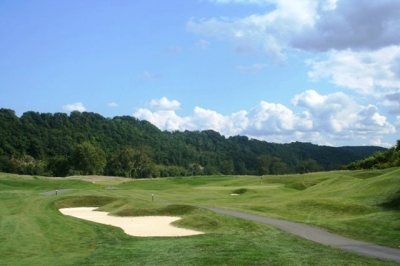 |
| The par four 10th hole appears to be very wide - but you'll still have to place your tee ball carefully to leave a good angle into the narrow green. |
It can also play ‘softer,’ if that’s possible on a Dye course. Norton explains. “There’s only one forced carry over a bunker, and that’s on the par three seventh hole, which plays 99 yards from the ladies’ tee. Everything else is open in front. By design, Pete concocted these narrow sections in the backs of the greens where we can put the pins in back and make the course play really tough.”
He continues, “By contrast, if we put the pins in front, you can run the ball up to them and it’ll play much easier for average players – in other words, I can make it friendly for women and a disaster for the men. And that’s what Pete gave us – a golf course that can be friendly, and at the same time, can be extremely difficult.”
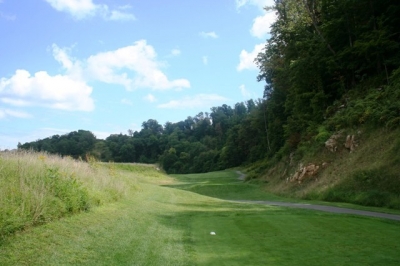 |
| The view from the 4th tee is very intimidating from the back sets of tees, but there's actually a lot of room to land the ball. |
Dye’s greens are kidney shaped and become very narrow in the back – so if Norton ‘fixes’ it to be difficult, back pins will add shots to the cards of even the best players.
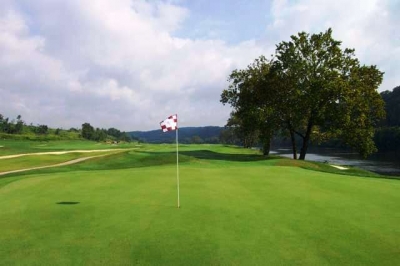
Somewhat surprisingly for a Pete Dye layout, the River Course’s greens are relatively flat. That too, was by design. “I had a conversation with Pete Dye and we were talking about trends in golf architecture,” Norton recalls. “Pete said there are the Oakmonts and Augusta Nationals of the golf world, but you can no longer ‘bury elephants’ in the greens when you’re trying to get the greens speeds up to 11 and 12 on the stimpmeter.”
 |
| Pete Dye wanted to 'open up the river,' and he's accomplished that goal throughout the River Course. Here, the par five 12th hole. |
Instead of the tough greens, the real challenge comes with your iron play – getting your approach shots close to the pin. At the River Course, precise iron play is a must, or you’re likely in a chipping area or a bunker and will have to depend on your short game to get you up and down.
The course is also in much better shape than the first time we saw it, which was shortly after it opened in 2005. Locals admit that it was opened too soon – and true to their opinions, it was amongst the ‘roughest’ looking courses we’d ever seen back then. Those days are over, thankfully, and now the playing surfaces are in the shape you’d expect from a high-end public facility.
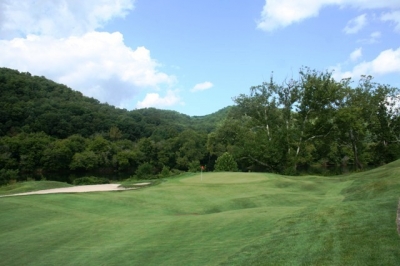 |
| From the fairway of the par four 8th hole, the target looks pretty small - but as with nearly all the holes at the River Course, it's open in front. |
Both nines include eye-catching holes, but the third and fourth holes deserve special mention. The third hole is ‘#1’ in a couple different ways – first, for pure yardage of river frontage, 588 yards from tee to green. Second, because it’s the River Course’s #1 handicap hole – long and seems relatively narrow – a test you’d expect from a Pete Dye par five.
The fourth hole adds more character to the course. Norton describes it: “It’s a very demanding hole from the back tees – there’s water on the left (of the tee shot landing area all the way up to the green). You’ve just come off the third hole which is right along the river, and you can see the whitewater rapids – and then you get to the fourth tee and there’s a rock wall on either side. It’s pretty cool.”
 |
| From behind the 3rd green, you'll see all of nature's splendor on display at the River Course. |
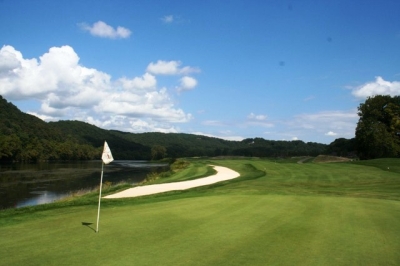
On the back side, we particularly enjoyed the closing two holes – the par three seventeenth and the difficult par four eighteenth (though it ‘bested’ us in every sense of the term). The seventeenth can play up to 260-yards from the back tees if Norton decides to put the pin in back, and of course the river waits to the right if you push your tee ball a bit too far. This hole is all about Dye’s brand of challenge, as there’s even a pot bunker if you miss short and right.
The eighteenth hole is another Dye classic. “It’s a narrow driving hole, the green itself is very demanding as far as your iron shot, especially if the pin is in back. Add in the fact that it’s abutted right up against the river (on the right), and you’re aware of the water the whole time. A lot of people hit both their first and second shots left to stay dry – but the closer you come to the river, the shorter the hole is,” Norton adds.
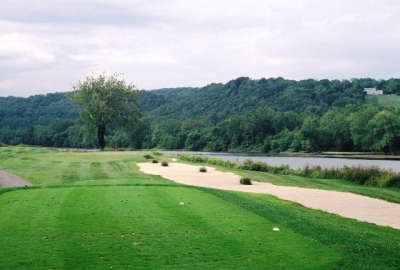 |
| The green of the par three 17th hole comes perilously close to the water - and there's enough sand to worry about, too. |
Beyond the quality of the golf course is the setting, of course, which is breathtaking and at times, overwhelming. Across the river from the golf course is a train track – and a couple trains passed during our round, along with a steady stream of kayakers and others enjoying the best that nature and golf has to offer. Norton says wildlife is abundant at the River Course, and it’s not uncommon to see a wide variety of wild creatures sharing the experience.
In other words, it’s the total package -- the River Course of Virginia Tech is a splendid way to ‘consume’ your time.
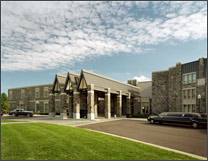 |
| The Inn at Virginia Tech |
Where we stayed
On our trip to Blacksburg, we took advantage of an opportunity to stay at the Inn at Virginia Tech – the university’s very own ‘guest house’ – located right next to the campus and offering 147 guest rooms and suites to those visiting the area.
The Inn is just a short walk to the heart of the university campus, and whether you’re there to relive the old college days, to play golf at the River Course or attend a sporting event, it’s highly recommended that you take in another aspect of the ‘college experience’ and stay at the Inn.
The guest rooms were well accented and roomy, and also featured free wireless internet – very handy for those who need to stay ‘connected’ even away from home. In-room amenities also include beverage stations, cable TV and room service for those desiring a bit of extra convenience.
Dining-in is also recommended at Preston’s restaurant, where we had a chance to sample the breakfast buffet – which includes all your breakfast favorites and even some you might not expect. In addition to the delicious meal, it was great to talk with the restaurant staff, which included students and ‘professionals,’ all enthusiastic about the school.
Another terrific feature at the Inn was the fitness center, which is complimentary to guests and provides yet another way to ‘stay in touch’ with your wellness routine while on the road.
Even though we’re not graduates of Virginia Tech, it was a lot of fun to take in the Hokie spirit at the Inn – which left a very positive impression of the school and its community.
The Inn at Virginia Tech and Skelton Conference Center
901 Prices Fork Road
Blacksburg, VA 24061
Phone: 540-231-8000 or 877-200-3360
Fax: 540-231-0146
Website: http://www.innatvirginiatech.com/
Details:
Pete Dye River Course of Virginia Tech
8400 River Course Drive
Radford, VA 24141
Phone: (540) 633-6732; 1-888-Pete-Dye
Website: www.rivercoursegolf.com
Course Designer: Pete Dye
Head Golf Professional: John Norton, PGA
Superintendent: Mark Cote
Tees/Yardage/Slope/Rating (Virginia Tech’s colors, of course):
Black: 7665 138/76.2
Maroon: 7088 135/74.2
White 6495 130/71.7
Orange 5903 127/68.9
Red 5142 120/69.5 (L)
Rates:
$80 on Saturdays and Sundays, $70 on Fridays, and $50 Monday through Thursday.
Twilight rate: 3:00 Monday through Thursday, $39; $56 on Friday, and $64 on weekends.
Rates include cart. Rates do not include range balls, but do include use of the range.
Here’s a link to the rates page:
http://www.rivercoursegolf.com/rates.html
| Related Links | Comments on this article? | |
|
Maryland National Golf Club Hollow Creek Golf Club Rocky Gap Resort PB Dye Golf Club in Ijamsville Whiskey Creek Golf Club |
E-mail Jeff Rendall, Editor: jrendall@golftheunitedstates.com |